Vote Early and Vote Often Refers to What Kind of Corruption
Public Corruption

Public corruption, the FBI's top criminal investigative priority, poses a cardinal threat to our national security and way of life. It can bear upon everything from how well our borders are secured and our neighborhoods protected to how verdicts are handed down in courts to how public infrastructure such as roads and schools are built. Information technology also takes a significant toll on the public'due south pocketbooks by siphoning off tax dollars—it is estimated that public abuse costs the U.S. authorities and the public billions of dollars each year. The FBI is uniquely situated to combat abuse, with the skills and capabilities to run complex undercover operations and surveillance.
Overview
The Bureau'due south Public Corruption program focuses on:
- Investigating violations of federal police force by public officials at the federal, land, and local levels of regime;
- Overseeing the nationwide investigation of allegations of fraud related to federal government procurement, contracts, and federally funded programs;
- Combating the threat of public abuse along the nation's borders and points of entry in order to subtract the country's vulnerability to drug and weapons trafficking, alien smuggling, espionage, and terrorism.
- Addressing environmental crime, election fraud, and matters concerning the federal government procurement, contracts, and federally funded programs.
In 2008, the FBI created the International Corruption Unit (ICU) to oversee the increasing number of investigations involving global fraud confronting the U.South. authorities and the corruption of federal public officials exterior of the continental U.S. involving U.Southward. funds, persons, businesses, etc. The ICU's tasks include:
- Overseeing the Agency'southward Foreign Corrupt Practices Human action (FCPA) and antitrust cases;
- Maintaining operational oversight of several International Contract Abuse Task Forces, which investigate and prosecute individuals and firms engaged in bribery, illegal gratuities, contract extortion, bid rigging, collusion, conflicts of involvement, product substitution, items and/or services invoiced without commitment, theft, diversion of appurtenances, and individual and corporate conspiracies on every level of U.Southward. government operations.
No other constabulary enforcement agency has attained the kind of success the FBI has achieved in combating corruption. This success is due largely to the cooperation and coordination from a number of federal, country, local, and tribal police force enforcement agencies to gainsay public corruption. These partnerships include, but are non express to the Department of Justice, Agency Offices of Inspector Full general; law enforcement agencies' internal diplomacy divisions; federal, country and local police enforcement and regulatory investigative agencies; and land and county prosecutor'southward offices.
Types of Corruption
Prison Corruption
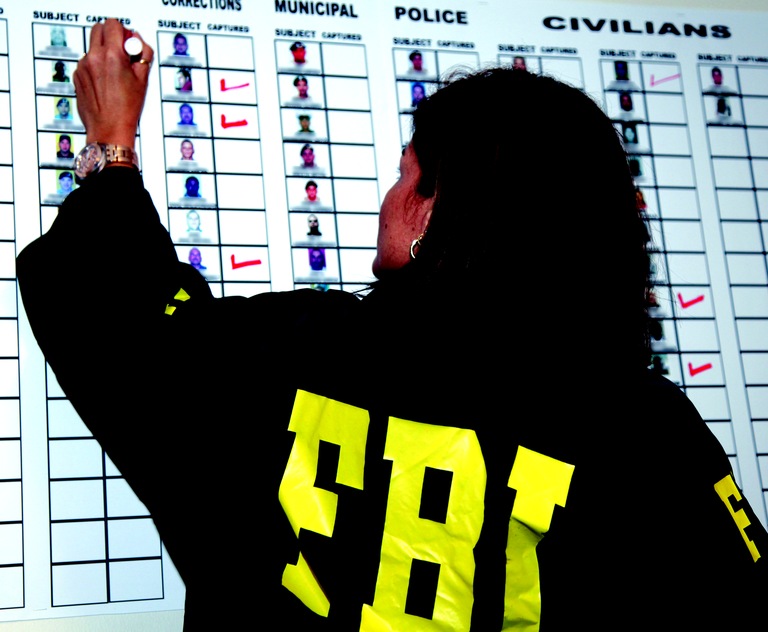
The FBI'due south prison abuse initiative, which began in June 2014, addresses contraband smuggling by local, state, and federal prison officials in exchange for bribe payments. Through this initiative, the Bureau works to develop and strengthen collaborative relationships with state/local corrections departments and the U.S. Department of Justice Function of Inspector General to help identify prison facilities plagued with systemic corruption and employ advisable criminal investigative techniques to combat the threat. Prison officials and staff being co-opted, even if unwittingly, betrays the public trust, threatens the integrity of the justice organisation in the U.S., and threaten national security interests overall.
Schemes to corrupt prison officials come in a multifariousness of forms, including:
- Testing: An offering of simple items, similar prison house commissary appurtenances, is fabricated to prison house officials. If accepted, the inmate confirms the official's administrative misstep, so urges the official to smuggle contraband nether threat of reporting the official'south misconduct.
- Agile recruiting: Civilian gang members with no prior criminal history are recruited by incarcerated gang members to utilise to become correctional officers, with promises of additional income paid by the inmates' criminal enterprise.
- Empathy: Prison inmates study corrections personnel working in the facility and decide whether detail staff members are susceptible to exploitation. This ploy typically results in improper interpersonal relationships and the corrupted official's integrity existence compromised to the benefit of the inmate.
Border Corruption
The federal authorities is responsible for protecting approximately 7,000 miles along the U.S. border and 95,000 miles of U.S. shoreline, and every mean solar day, over a million people visit the U.Southward. and enter through one of the more than 300 official ports of entry into the U.Southward., too as through seaports and international airports. The FBI recognizes the very real threat public corruption at our nation'southward borders and all other ports of entry pose.
Common acts of edge corruption involve drug trafficking and alien smuggling. Throughout the U.S., the FBI has investigated corrupt authorities and law enforcement officials who have bribes and gratuities in return for assuasive loads of drugs or aliens to pass through ports of entry or checkpoints; protecting and escorting loads of contraband; overlooking contraband; providing needed documents, such as immigration papers and driver's licenses; leaking sensitive law enforcement information; and conducting unauthorized records checks.
Border corruption potentially impacts national security equally well—corrupt officers might believe they are accepting a bribe simply in return for assuasive a carload of illegal aliens to enter the U.South., when they might actually be facilitating the entry of a group of terrorists. Or a corrupt official who expedites immigration paperwork or helps obtain an identification certificate in return for a bribe or gratuity might actually be facilitating an operation of a terrorist cell, foreign counterintelligence network, or criminal enterprise.
Oftentimes the Bureau brings its expertise to bear on articulation investigations with its partners in federal, country, and local law enforcement. Many of these investigations involve FBI border corruption chore forces and working groups located in nearly two dozen cities along our borders. Members of these job forces and working groups stand up shoulder to shoulder to combat decadent officials, both operationally and through the sharing of intelligence and information, along with the use of trend assay, lessons learned, and all-time practices.
Federally, the FBI coordinates investigative efforts forth the borders with the Department of Homeland Security Office of Inspector General; Customs and Edge Protection Internal Diplomacy; Transportation Security Assistants; Drug Enforcement Administration; Bureau of Alcohol, Tobacco, Firearms, and Explosives; U.Southward. Immigration and Community Enforcement-Function of Professional Responsibility.
International Corruption
The FBI's International Abuse Unit (ICU) is the leading investigative entity in combating strange corruption. ICU manages v programs:
- Foreign Blackmail/Strange Corrupt Practices Act (FCPA)
- Foreign Corruption/Kleptocracy Programme
- Antitrust
- International Fraud Confronting the Government
- International Corruption of Federal Public Officials
Foreign Corrupt Practices Act
ICU has management responsibility and plan oversight for FBI investigations nether the FCPA. The 1977 legislation has ii main provisions. The first deals with bribery of foreign officials, and the second deals with accounting transparency requirements under the Securities Exchange Act. The dual elements were designed to facilitate parallel criminal and civil enforcement to stem corruption and promote fair business practices worldwide. The anti-blackmail provision makes it illegal for U.Due south. companies and certain foreign companies to ransom foreign officials to obtain or retain business organization. The bribes tin can be in the form of money or any other items of value. The accounting provision of the FCPA focuses on the Securities Exchange Act requirements applying to all foreign companies whose securities are listed on the U.S. stock exchanges and U.S. companies.
The United States cannot charge the strange official under the FCPA; rather, the United states works together with international law enforcement partners to investigate U.Southward. subjects who are complicit in paying bribes to foreign officials. The supply and demand equation of ransom paying and receiving illustrates the FCPA and kleptocracy violations as two sides of the same coin. For more data, see this detailed FCPA Resources Guide.
Kleptocracy
Kleptocracy, literally meaning "the rule past thieves," is a form of political corruption in which the ruling regime seeks personal gain and status at the expense of the governed. Through graft and embezzlement of state funds, corrupt leaders aggregate tremendous wealth at the expense of the broader populace. Some of the most egregious examples have occurred in countries with very high rates of poverty. The inherent challenge for corrupt leaders is covertly expatriating and belongings money in secure locations where information technology tin can exist accessed in the futurity. Generally, that requires international motility of funds. When transfers occur in U.Due south. dollars or transit the U.S. banking system, federal money laundering jurisdiction is established. The FBI initiates money laundering investigations to trace the international movement of avails and, in conjunction with foreign partners, forfeit and repatriate assets back to legitimate government in victim countries.
Antitrust
ICU has program management responsibleness for the FBI's antitrust investigations, both domestic and international, which target conspiracies amongst competitors to set prices, rig bids, or allocate markets or customers. These conspiracies deprive U.S. consumers of true competition, an economical bedrock of our free and democratic society. Perpetrators oftentimes operate in multinational companies that enjoy in illegal profits at the expense of U.S. consumers. Stolen by cartels, the ill-gotten gains and competitive advantages reduce supply, eliminate incentives to compete by offering better and more innovative products and services, and destabilize economical markets.
International Contract Abuse
ICU has program management responsibility over cases involving international fraud against the government and international abuse of federal public officials. The FBI was a co-founder of the International Contract Abuse Task Forcefulness, which was created in 2006 with the goal of addressing contract fraud concerns. These concerns stemmed from overseas U.S. government spending during the wars in Afghanistan and Republic of iraq. These cases typically involve bribery, gratuities, contract extortion, bid rigging, collusion, conflicts of interest, production substitution, items/services invoiced without delivery, diversion of goods, and corporate and individual conspiracies at various levels of U.Southward. government operations.
ICU'south program extends beyond the war effort to include worldwide contingency operations involving U.Due south. armed forces actions, strange aid and evolution, and humanitarian aid in whatsoever international region. Spending on these programs is highly susceptible to abuse and fraud by those wishing to take reward of the chaotic circumstances surrounding these benevolent endeavors. Misuse of U.S. funds overseas poses a threat to the United States and other countries by promoting corruption within the host nation, damaging diplomatic relations, inadvertently supporting insurgent activeness, and potentially strengthening criminal and terrorist organizations.
International Anti-Corruption Coordination Centre
The FBI works with multiple law enforcement partners from around the world equally part of the International Anti-Corruption Coordination Centre (IACCC). Established in 2017, the IACCC is a coordinated and collaborative effort to provide data, assistance and other support to agencies investigating public corruption offenses.
IACCC Participants
- Australia: Australian Federal Police force
- Canada: Regal Canadian Mounted Police force
- Interpol
- New Zealand: Serious Fraud Role, New Zealand Police
- Singapore: Decadent Practices Investigation Bureau
- United Kingdom: National Offense Agency
- United states of america: FBI, DHS (ICE, HSI)
Acquire More than
- IACCC Brochure (pdf)
ICU Initiatives
ICU oversees ii big initiatives: the program management of four international corruption squads defended to investigating FCPA, kleptocracy, and antitrust cases and the development of a robust individual sector outreach program.
International Corruption Squads
The international corruption squads (ICS), based in Los Angeles, Miami, New York City, and Washington, D.C., were created to accost the national impact of foreign blackmail, kleptocracy, and antitrust schemes. These schemes negatively touch on U.S. financial markets and economic growth when inadequately addressed. They are unique in nature in that they are international matters with the overt criminal acts typically occurring exterior U.S. borders. Without these dedicated resource, it was difficult for FBI divisions to investigate international matters that did non directly bear on their area of responsibleness as conspicuously as other violations; therefore, the FBI created four international corruption squads to enable a focus on international corruption matters without draining resources from the field.
The ICS are a vital resource to combat international cartels and corruption. The violations addressed by the ICS are equally recognized by both DOJ and the FBI equally risks to U.S. national interests. These squads non only lend boosted resource to a global threat, but they besides permit the FBI to assault the matters and use sophisticated investigative techniques that have long been successfully utilized past the FBI to address complex criminal matters.
Private Sector Outreach
In an endeavor to combat international corruption and cartels, the FBI's ICU created a proactive strategy that places an emphasis on strengthening existing relationships and forging new partnerships in the private sector. This is not new to the FBI. Nosotros have leveraged relationships throughout our 100+ years of investigations—from fighting organized law-breaking to combating terrorism. Nonetheless, we believe by fostering these vital relationships, the FBI volition be able to effectively fight international corruption to ensure a fair and competitive global market environs for companies resulting in a strong U.S. economy.
nuneztolopead1963.blogspot.com
Source: https://www.fbi.gov/investigate/public-corruption
0 Response to "Vote Early and Vote Often Refers to What Kind of Corruption"
Enregistrer un commentaire